

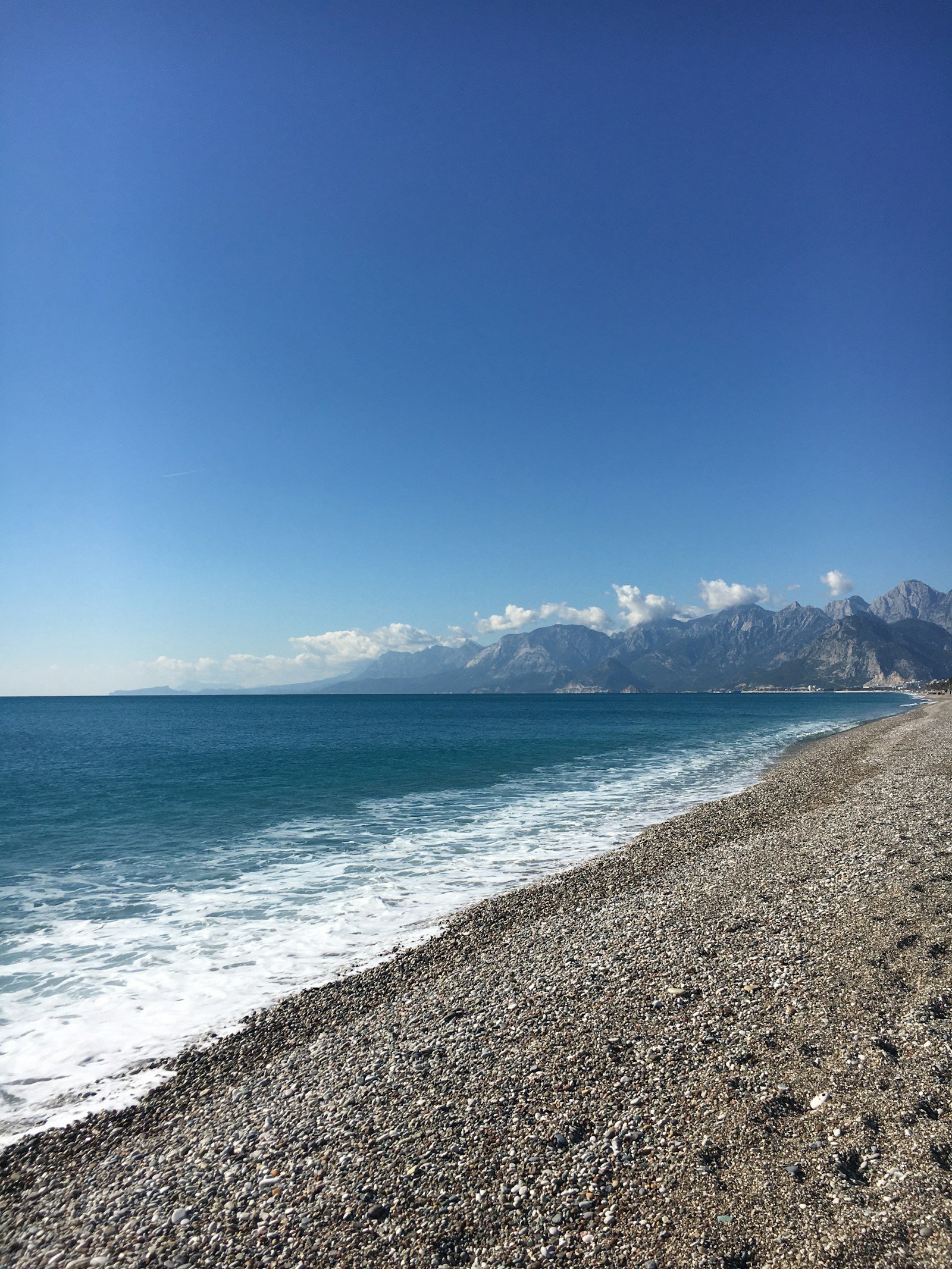
Kıyı Kanunu: Why Nobody Owns the Turkish Beachfront
Turkey’s Coastal Law puts the shore itself beyond private ownership and draws two measured lines inland from it. Understanding where those lines fall is the difference between buying a sea view and buying a dispute.
The sea is not the boundary. A surveyed line is.
Almost every foreign buyer who looks at the Turkish coast begins with the same mental model: the sea is the edge of the land, so the closer a property sits to the water, the more of something valuable it has. Turkish law does not work that way. Under the Coastal Law — Kıyı Kanunu, Law No. 3621, enacted on 4 April 1990 — the sea is not the operative boundary at all. The boundary that governs what can be owned and what can be built is a surveyed line drawn some distance inland from the water, and everything seaward of it belongs to the public.
The law sets out four terms in Article 4, and they stack on top of each other. The kıyı çizgisi, the coastline, is the line formed by joining the points at which the water touches the land, excluding flood conditions. The kıyı kenar çizgisi, the shore edge line, is the natural landward boundary of the sand, shingle and rock that water movement has formed. The kıyı — the shore — is the area between those two lines. And the sahil şeridi, the coastal strip, is the area at least 100 metres wide measured horizontally landward from the shore edge line.
Once those definitions are in place, the restrictions follow mechanically. Article 5 provides that the coasts are under the dominion and disposition of the State and are open to everyone’s equal and free use, with the public interest taking priority in how coasts and coastal strips are used. Article 6 provides that no structure may be built on the shore. The practical consequence is that the single most marketed feature of Turkish coastal property — direct, exclusive, owned access to the water — is the one thing the statute will not allow anyone to sell you.
The gap between those two questions is where problems start. A parcel can be genuinely close to the sea and still have very little buildable area, because the coastal strip and the approach limit eat into it from the seaward side. A terrace, a boundary wall or a landscaped garden can sit partly on public land without anyone having intended it. And on stretches of coast where the shore edge line has never been formally determined, the extent of what is buildable is not merely unknown — it is legally unresolved.
Kıyı Kanunu — Key Provisions
Coastal Law No. 3621 and its principal amendment
Seven checks before you buy anything on the coast
In order. The first three establish where the lines fall; the rest establish whether what is standing on the parcel respects them.
Locate the parcel officially, not on a sales map
Get the island and parcel numbers and look the plot up on the state land parcel system so that you are working from registered boundaries. Our guide to checking a Turkish land parcel online walks through how to do this yourself before you travel.
Establish whether the shore edge line has been determined
Article 5 makes determination of the kıyı kenar çizgisi a precondition of planning and implementation on the coast and in the coastal strip. Where it has not been determined and a request is made, the law requires it to be determined within three months of that request. Until then, treat the seaward extent of the parcel as unresolved.
Obtain the development status of the parcel
The municipality issues the imar durumu, which states what the applicable plan permits. On a coastal plot this is where you see how much of the parcel is absorbed by the coastal strip and where the 50-metre approach limit crosses it.
Read the annotations on the title deed
Coastal parcels attract annotations that inland ones do not, and they belong on the same checklist as mortgages and liens. Our note on reading the encumbrances on a Turkish title deed explains what the register records and how to obtain the full entry.
Check the permit history of anything already built
A building standing closer to the water than current rules allow is not automatically unlawful — it may predate the Coastal Law or have been authorised under an earlier plan. What matters is whether it has a building permit and an occupancy certificate. Where neither exists, our explainer on the Yapı Kayıt Belgesi sets out what a registration document does and does not cure.
Walk the seaward boundary and look for encroachment
Walls, terraces, steps, pontoons, planting and parking regularly drift beyond a parcel onto public land. Article 6 prohibits walls, fences, trenches and similar barriers on the shore. Anything of yours sitting on State land is an occupation, and occupations are charged for.
Price the risk before you commit, not after
Every item above is resolvable in advance and expensive afterwards. If the shore edge line is undetermined, or a structure encroaches, or the permit file is incomplete, those are negotiating points while you are still a prospective buyer and they are your problems the moment the transfer registers.
Four zones, counting inland from the water
The shore itself. Between the waterline and the shore edge line sits the kıyı. Article 5 places it under the dominion and disposition of the State and opens it to everyone’s equal and free use. Article 6 provides that no structure may be built there, and goes further: no walls, fences, trenches or similar barriers; no excavation that would alter the coastline; no removal of sand or gravel; no dumping of rubble, soil, slag or waste. The article does allow specified exceptions by decision of a development plan, and these are infrastructure categories rather than private ones — piers, ports, breakwaters, bridges, lighthouses, shipyards and fish farms, with further categories added by later amendments including cruise and yacht ports, certain sports and health facilities and energy transmission lines.
The first fifty metres. Article 5, as amended by Law No. 3830 of 1 July 1992, provides that structures to be built in coastal strips may approach the shore edge line by at most 50 metres, and that the area between that approach limit and the shore edge line may only be arranged for pedestrian ways, walking, resting, viewing and recreation. This is the band that most often surprises buyers. It is not a setback that can be negotiated parcel by parcel; it is the statutory minimum distance for new building in the coastal strip.
The rest of the coastal strip. The sahil şeridi runs at least 100 metres inland from the shore edge line, and Article 5 provides that its depth is not to be less than that, determined with regard to the uses in and behind the strip and to natural thresholds. In other words, 100 metres is a floor rather than a fixed figure, and on a given stretch of coast the strip may be deeper. Article 8 restricts what may happen inside it: in areas without an implementation development plan, no structures or facilities may be built within the distances set in Article 4. Where a plan does exist, Article 8 permits day-use tourism structures and facilities, excluding overnight accommodation, provided they are open to public benefit, while continuing to prohibit barriers, excavation and the dumping of pollutants.
Behind the strip. Landward of the coastal strip, ordinary planning law takes over and the parcel is governed by its development plan in the normal way. This is where the great majority of coastal housing stock actually sits, and where a foreign buyer is usually buying. The point of understanding the three bands in front of it is not that they are available to you — it is that they determine the outlook, the access and the permanence of what you are buying. A parcel separated from the water by a protected 100-metre strip has a view that is far harder to build out than one where the land in front is ordinary development land.
What is permitted where
Reading from the water inland. Private ownership and building rights expand as you move away from the shore edge line.
| Question | The shore (kıyı) | First 50 m of the strip | Rest of the strip | Behind the strip |
|---|---|---|---|---|
| Can it be private property? | No — State dominion | Yes | Yes | Yes |
| Public right of free access | Yes — equal and free | Arranged for public use | Per the plan | No |
| New buildings allowed | No (Art. 6) | No — 50 m approach limit | Only per Art. 8 | Per the development plan |
| Walls, fences and barriers | Prohibited | Prohibited | Prohibited | Per the plan |
| Paths, rest and recreation | Public use | Expressly permitted | Yes | Yes |
| Day-use tourism, no accommodation | No | No | Where a plan exists | Per the plan |
| Removing sand or gravel | Prohibited | Prohibited | Prohibited | Not governed here |
| Infrastructure exceptions | Listed categories only | Per the plan | Per the plan | Per the plan |
| Needs the shore edge line fixed first | Yes | Yes | Yes | Not directly |
Six coastal claims, and what to ask about each
None of these phrases is necessarily dishonest. All of them describe something other than what a buyer tends to hear.
“Private beach”
Ask what the legal basis of the arrangement is. The shore is State land open to everyone’s equal and free use, so what exists is at best a permitted use, and the public right of access survives it.
“Twenty metres from the sea”
Ask whether that is measured to the water or to the shore edge line, and whether the building is new. New building in the coastal strip may come no closer than 50 metres to that line.
“The view can never be built out”
Sometimes true, and checkable rather than a matter of trust. Get the development status of the land in front and see whether it falls inside the protected strip or is ordinary development land.
“Land being reclaimed for the project”
Article 7 is explicit that filled land is under State dominion and cannot be the subject of private ownership. A project premised on converting reclaimed ground into private title is premised on something the law does not permit.
“The wall has always been there”
Longevity is not authorisation. If part of the property sits on the public shore, the occupation can be charged for — see our guide to ecrimisil, the occupation charge that arrives after you buy.
“The line will be confirmed later”
Determination of the shore edge line is a precondition of planning on the coast, and where requested in an area it has not been fixed, the law requires it within three months. Treat later as a reason to wait.
Where the Coastal Law actually shows up in a purchase
The Coastal Law rarely announces itself. It surfaces as a surveyor’s note, a line on a plan, or a refusal from a municipality, and by then the buyer is usually committed. Three patterns account for most of the trouble we see.
The plot that is smaller than it looks. A parcel of a given area on paper can have a materially smaller buildable footprint once the coastal strip and the 50-metre approach limit are drawn across it. Buyers who price land on total area rather than developable area overpay, and discover the gap when they commission a design. On a plot bought for building, the development status is not a formality to collect after exchange — it is the document that tells you what you are buying. Our guide to buying land in Turkey covers the wider plot-purchase process.
The structure that crept seaward. Terraces, retaining walls, staircases down to the water and landscaped gardens are added over decades, often informally, and property boundaries on the ground stop matching the register. Where part of what you have bought sits on the public shore, the State can charge for that occupation, and the charge is levied on the occupier rather than on whoever built it. This is the single most common way the Coastal Law converts into a bill for a foreign owner.
The stretch of coast where the line was never drawn. On less developed coastline, the shore edge line may simply never have been determined. That is not a technicality. Article 5 requires its determination before planning and implementation on the coast and in the coastal strip, so until it exists, the development potential of a seafront parcel is genuinely unresolved. Buying on the assumption that the line will fall conveniently is speculation, and it should be priced as such.
The reassuring part is that every one of these is a documents problem, and documents can be obtained before money moves. The Turkish coast is one of the most attractive property markets in the Mediterranean, and the Coastal Law is a large part of why its best stretches still look the way they do. It protects the thing buyers are actually paying for. It just does not let them own it.
For the broader picture of buying on the Turkish coast, see our regional guides to Ölüdeniz, Göcek and Kalkan, our note on what a second home actually involves, and the Turkey property guides index. The errors that cost foreign buyers the most are collected in our guide to the pitfalls foreign buyers still fall into.
Considering a coastal plot or a seafront property?
We check where the shore edge line falls, what the development status permits, and whether anything on the parcel encroaches on public land.
Kıyı Kanunu — frequently asked questions
The questions foreign buyers ask most often about beachfront ownership, setbacks and what can be built near the water.
Where to go next
The rest of our land, zoning and coastal material for foreign buyers in Turkey.
- Parsel Sorgu — checking a Turkish land parcel online before you travel.
- İmar Durumu — what can legally be built on a given parcel.
- Ecrimisil — the occupation charge that arrives after you buy.
- Land for sale in Turkey — what foreign buyers need to know before buying a plot.
- Yapı Kayıt Belgesi — when a property has no building permit.
- Kamulaştırma — what happens if the State expropriates your property.
- Tapu — how to read a Turkish title deed.
- Turkey property guides — the full index for foreign buyers.
Know where the line falls before you commit
Tell us the coastal property you are considering and we will establish where the shore edge line sits, what the development status allows, and whether any part of the plot encroaches on public land. We work with licensed Turkish conveyancers and surveyors, and every transaction settles through the secure payment system.



Join The Discussion