Bodrum Property for Sale: A Foreign Buyer’s Guide to the Peninsula
Bodrum is not a town with suburbs. It is a peninsula of separate coastal villages, each with its own season, its own buyer and its own planning constraints. Choosing the wrong bay is the most expensive mistake a foreign buyer makes here — and it is entirely avoidable.
A peninsula of villages, not a town with suburbs
Almost every foreign buyer arrives in Bodrum having researched “Bodrum” as though it were a single market. It is not. The peninsula runs west from Bodrum town into the Aegean, and around its coast sit something in the order of twenty distinct settlements — Yalıkavak, Türkbükü, Gümüşlük, Bitez, Turgutreis, Ortakent, Torba, Gündoğan, Konacık and the smaller bays between them. They are close together on a map and genuinely different in practice.
What separates them is not scenery so much as rhythm. Some of these villages are built around a short, intense summer and go quiet in October. Others carry a resident population through the winter, with schools, year-round shops and a working local economy. A property that is perfect as a July house can be an isolating place to spend February, and the reverse is equally true: a buyer looking for a lively summer scene will not find it in the quietest protected bays.
The legal and procedural side of buying here is the same as anywhere else in Turkey. Ownership is recorded centrally by the Land Registry, purchase funds move through the mandatory secure payment system rather than passing directly to the seller, and compulsory earthquake insurance must be in place before a transfer can be registered. If you have not read it yet, our guide to the pitfalls foreign buyers still fall into covers that process end to end, and who can buy and where covers the ownership rules in detail.
What follows is the part that is specific to Bodrum: how the villages differ, what the official figures actually show, and the three checks that carry more weight on this peninsula than they do elsewhere in Turkey.
Bodrum — Key Facts for Buyers
The framework every purchase here sits inside
What the official figures actually show
Bodrum does not get its own national sales statistics. It is a district of Muğla, and Muğla is the level at which the Turkish Statistical Institute publishes monthly house sale data. That is still the most reliable read available on the market this property sits in, and it is more useful than the price claims that circulate in agency marketing.
For July 2026, the reported Muğla figures were 1,662 homes sold in total, split into 528 first-hand and 1,134 second-hand transactions. Of that total, 30 went to foreign buyers. British citizens were the largest single foreign group with 13 purchases, ahead of Ukraine with three, and Russia and Italy with two each. The remaining foreign purchases were spread across buyers from Poland, Belarus, Kazakhstan, Uzbekistan, Turkmenistan, Egypt, the United States, Austria and Belgium.
Two conclusions follow, and both should change how you search.
The resale market is where the choice is. Second-hand transactions outnumbered new-build sales by more than two to one in July. On the Bodrum peninsula specifically, a great deal of the most desirable stock — the older stone-built houses in the protected villages, the properties closest to the water in bays that are now fully built out — can only come to you as a resale. Buyers who restrict themselves to new developments are searching a minority of the market.
Comparable evidence is thinner than it looks. Thirty foreign purchases across an entire province in a month is not a deep dataset. Spread that across a dozen Bodrum villages plus Marmaris, Fethiye, Datça and Dalaman and there may be very few genuinely comparable recent sales in the bay you are looking at. This is the reason this guide does not quote you a price per square metre for Yalıkavak or Bitez: any single figure would be built on too few transactions to be honest. For the national picture and the official series, see our breakdown of what the official house price numbers actually say.
Six Bodrum addresses, and who each one actually suits
These are the bays foreign buyers ask about most often. The differences between them are seasonal and practical rather than a matter of prestige.
Yalıkavak
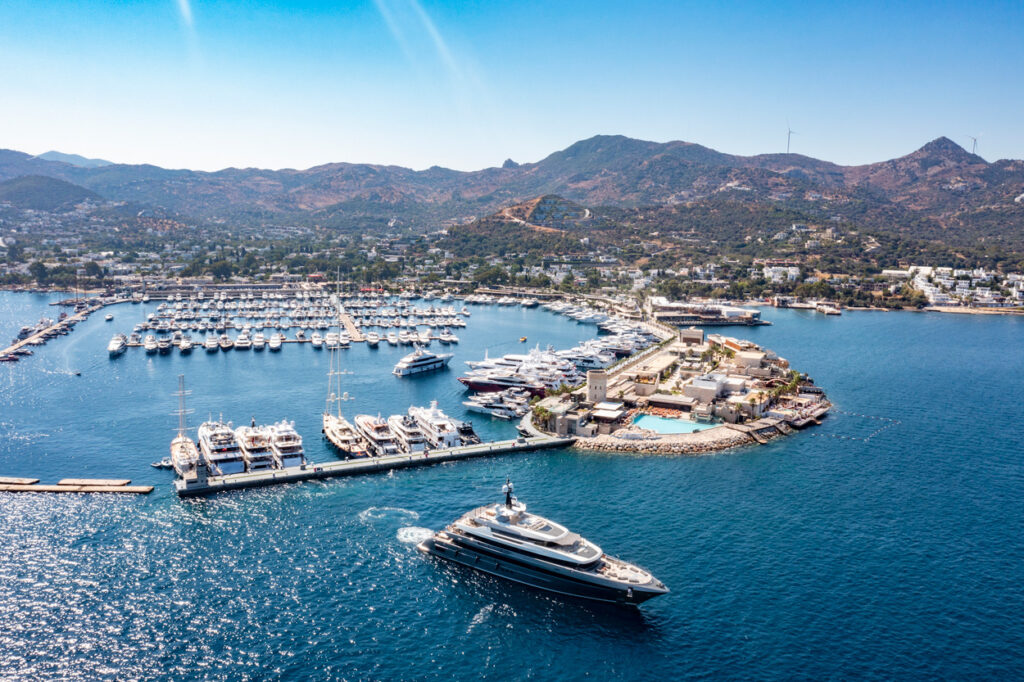
The peninsula’s marina address at the western end, built around a large yacht harbour with international retail and restaurants. Intense in season, considerably quieter out of it. Suits a summer property where marina access and the social scene are the point.
Türkbükü & Gündoğan
The sheltered north coast, with boutique hotels, jetty restaurants and hillside houses above the bay. The most concentrated summer season on the peninsula. Suits buyers whose use is genuinely limited to high summer.
Gümüşlük
The quietest and most heavily protected of the well-known villages, on the far western shore. Conservation designations shape what can be built, which is exactly why its character has survived. Suits buyers who want low-rise and low-noise, and who accept slower approvals.
Bitez & Ortakent
South-facing bays a short drive from Bodrum town, with shallow beaches, tangerine groves inland and a genuine winter population. The most balanced choice for someone who intends to spend more than the summer here.
Turgutreis
The largest settlement after Bodrum town, on the western tip, with its own marina, a working high street and everyday infrastructure that stays open year-round. Suits buyers who want ordinary life available on foot rather than a resort.
Torba & Konacık
The north-eastern approach and the inland service hub. Torba is the first bay you reach from the airport road; Konacık is where the supermarkets, hospitals and trade suppliers are. Practical rather than picturesque, and priced accordingly.
How the Bodrum bays compare on the things that matter
Season length and winter life are the two variables that decide whether a Bodrum property works for you. Scroll the table sideways on a phone.
| Area | Character | Open year-round? | Walkable everyday shops? | Best suited to |
|---|---|---|---|---|
| Yalıkavak | Marina, international retail, high-summer scene | Largely seasonal | Yes, in the town centre | Summer home, marina access |
| Türkbükü / Gündoğan | Sheltered north-coast bays, boutique and low-rise | Strongly seasonal | Limited out of season | High-summer use only |
| Gümüşlük | Protected village, low-rise, deliberately quiet | Seasonal | Limited | Character buyers, slow pace |
| Bitez / Ortakent | Shallow south-facing bays with a resident population | Yes | Yes | Year-round living, families |
| Turgutreis | Working town with a marina and full high street | Yes | Yes | Permanent residence, retirement |
| Torba / Konacık | Airport-side bay and the inland service hub | Yes | Yes | Practical bases, frequent flyers |
| Bodrum town | The castle, the old town, the two harbours | Yes | Yes | Town life, letting demand |
Three checks that carry more weight in Bodrum
The standard Turkish purchase checks apply here in full. But three of them do more work on this peninsula than they do in a new-build district of a mainland city, and they are worth understanding before you make an offer rather than after.
1. The occupancy permit, and whether the building matches its approvals
The occupancy permit — the iskan — certifies that a finished building matches the plans approved for it and passed final inspection. Bodrum has a long coastal building history, a great deal of stock that has been extended, converted or rebuilt over decades, and conservation overlays that constrain what was permitted in the first place. That combination makes the gap between approved and built a live risk rather than a theoretical one.
A missing iskan is not automatically a reason to walk away, but the reason it is missing changes everything. Ask for the document. If it does not exist, establish precisely why, and have that answer checked independently before any money moves.
2. The title deed annotations, not just the front page
A Turkish title deed records more than an owner and an address. Registered against it you may find mortgages, liens, disputes and formal annotations known as şerh. These travel with the property. In a resale-dominated market like Muğla’s, where two-thirds of July’s transactions were second-hand, the chance that a property has some history registered against it is meaningfully higher than in a first-hand sale from a developer.
Ask for the complete title deed record including the encumbrances page, and have someone competent read it. This is covered in more depth in our guide to reading a listing and a title deed.
3. The service charge, and what it covers in winter
A large share of Bodrum’s foreign-owned stock sits inside managed complexes with pools, gardens, gated entrances and, at the upper end, concierge and beach club facilities. All of that is funded by a service charge set by the site’s own management rather than by any national rule, and it continues through the months you are not there.
This is the running cost foreign buyers most often underestimate on this coast, because the amenities that make a property attractive in August are precisely the ones that cost money to maintain in January. Ask the site management — not the seller, and not the selling agent — for the actual charges levied over the last two years, and for any special assessments raised in that period.
Buying in Bodrum, in the order that protects you
Nothing on this list is difficult. Running it in the wrong order — or after a payment — is what turns a straightforward purchase into a problem.
Decide the use before the bay
Summer house, year-round home or letting asset. This single decision eliminates most of the peninsula and turns twenty villages into a shortlist of three. Everything below is easier once it is settled.
Visit out of season, not only in August
The difference between a Bodrum bay in August and the same bay in February is larger than anywhere else on the Turkish coast. If you can only make one trip, make it the off-season one — the summer version sells itself.
Get a Turkish tax number and open a bank account
Both are needed before the transaction can proceed, and both are straightforward. Doing them early removes a common source of delay later in the process.
Instruct your own lawyer
Your own, not the seller’s and not one recommended solely by the selling agent. Their job is to pull the full title record, read the annotations and confirm the zoning status of the parcel.
Confirm the zoning and conservation status of the specific parcel
Especially in and around the protected villages. What the property currently is matters less than what the plan governing it permits, and that is a written answer you are entitled to have before committing.
Verify the occupancy permit and commission a licensed valuation
The iskan tells you the building is what it claims to be. An SPK-licensed appraisal tells you what it is assessed to be worth, independent of the asking price.
Arrange DASK and settle through the secure payment system
Compulsory earthquake cover must be valid before the Land Registry will register the transfer. Purchase funds move through the mandatory secure payment system, and are released to the seller only once ownership is registered in your name.
Set up the holding arrangements before you fly home
Utilities in your name, the service charge mandate, a key holder, and if you intend to let, the permissions that letting requires. Arranging this from abroad afterwards is considerably harder than arranging it on the ground.
Considering a specific Bodrum property?
We will run the title record, annotations, zoning and permit checks on the parcel before anything is signed.
Bodrum property — frequently asked questions
The questions foreign buyers ask most often about buying on the Bodrum peninsula.
Where to go next
The rest of our foreign-buyer library, from the wider Aegean coast to the running costs of ownership.
- Turkey property guides — the full index of our foreign-buyer guides.
- Property in Bodrum — our overview of the Bodrum market and the developments we work with.
- Villas for sale in Turkey — regions, title types and the checks that matter.
- Marmaris property for sale — the neighbouring Muğla coast, bay by bay.
- Property taxes in Turkey — what owners actually pay each year.
- Renting out property in Turkey — the letting rules owners keep missing.
- Property management in Turkey — running a coastal property from abroad.
- Mandarin Oriental Bodrum — branded residences on the peninsula.
Have the Bodrum checks run before you commit
Tell us the bay and the property you are considering and we will run the title deed record, annotations, zoning and occupancy permit checks before anything is signed. We work with licensed Turkish conveyancers and SPK-licensed appraisers, and every transaction settles through the secure payment system.
Buyer’s Guide · Turkey Property Guides · Contact

Join The Discussion