

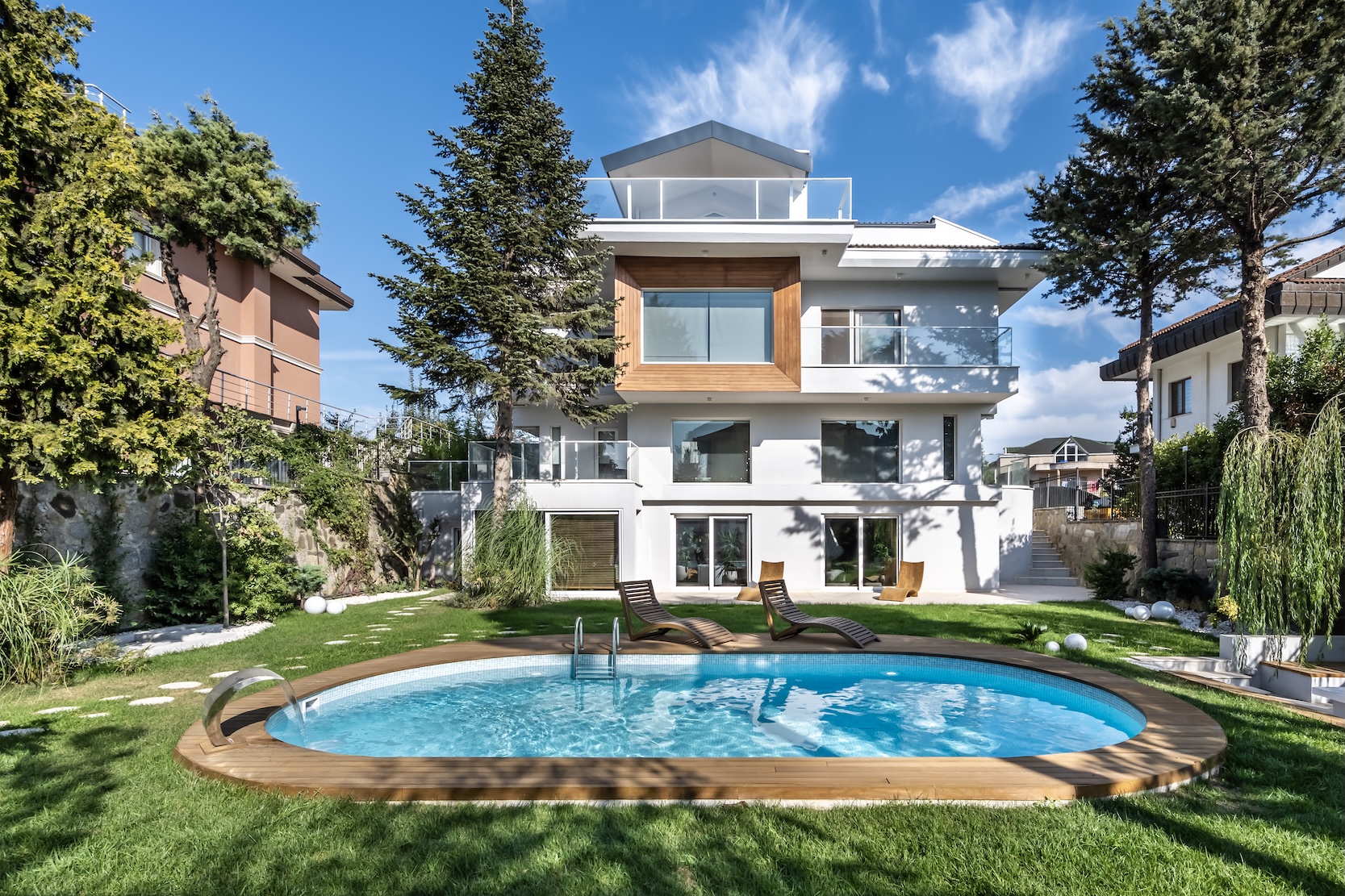
Villas for Sale in Turkey: Regions, Title and the Checks That Matter
A villa is not a larger apartment. You are buying land, a structure and often a site management regime, and each of those carries checks an apartment purchase never raises. Here are the regions worth knowing and the due diligence that goes with them.
A villa is a land purchase with a house on it
Buyers searching for villas for sale in Turkey usually arrive with a clear picture of the house and a very vague one of everything underneath it. That is the wrong way round. When you buy an apartment you are acquiring one independent section inside a building somebody else built, maintains and insures; the boundaries of what you own are walls. When you buy a villa you are acquiring a parcel of land, whatever has been built on that parcel, and responsibility for all of it.
This changes the due diligence rather than the transaction. The purchase mechanics are the standard national process: the deed is issued in your own name as full freehold, ownership is recorded centrally by the Land Registry, and since 1 July 2026 purchase funds must move through a government-mandated secure payment system instead of passing directly to the seller. What widens is the list of things worth checking before that money moves — the plot boundaries, the land’s designated use, whether the pool and the boundary wall were built with permission, the form of title, and whether the property is genuinely detached or an independent section inside a managed site.
The regional differences matter just as much. Turkey’s villa markets are not price tiers of one product — a Yalıkavak hillside house, a Belek golf villa and a family home in Acarkent are different assets with different buyers behind them. For the wider purchase walk-through see our Turkey property buyer’s guide, and for the errors that still catch people out, the seven pitfalls foreign buyers fall into.
Villa Purchase — Key Checkpoints
What has to be true before ownership can transfer
Buying a villa, in the order it actually happens
The same sequence applies from Bodrum to Istanbul. What changes region to region is what you are buying, not how the purchase runs.
Decide detached or managed site first
A standalone villa on its own parcel and a villa inside a gated site are different products with different obligations. The site brings security, shared pools, landscaping and maintenance, and with them a management regime, its rules and a recurring service charge. The standalone house brings autonomy and the full cost of every repair. Nothing else in the search makes sense until this is settled.
Get a tax number and a Turkish bank account
A Turkish tax number is the prerequisite for nearly every subsequent step, from opening a bank account to registering utilities in your name. Both are straightforward, and both are far easier to arrange early than in the week before a transfer appointment.
Check the plot as carefully as the house
A villa purchase is a land purchase. Confirm from the title deed record that the registered boundaries match what you were walked around, that the parcel's designated use permits the existing structure, and that any pool, terrace, outbuilding or boundary wall was actually built with permission rather than added afterwards.
Read the annotations page of the title deed
Mortgages, liens, ownership disputes and formal şerh annotations are registered against the property and appear on the annotations page, not the front of the deed. This is the single check that most often separates a clean purchase from a contested one, and it costs time rather than money.
Confirm the form of title and the occupancy permit
A completed villa should carry full condominium ownership — kat mülkiyeti — rather than a construction servitude, kat irtifakı, which signals that the building process was never formally closed out. Alongside it, ask for the iskan, the occupancy permit confirming the finished building matches its approved plans.
Complete the military clearance and zone checks
Villas sit disproportionately on hillsides, coastal fringes and the edges of towns, which is exactly where restricted zones are found. The clearance check confirming the property is not inside a prohibited or special security zone should be run early, not treated as end-of-process paperwork.
Arrange DASK, then route the money correctly
DASK cover must be in place before the Land Registry will complete the transfer, and utilities cannot be connected without it. Every payment, deposits included, goes through the secure payment system, where funds are held in a special account and released only once ownership has been registered in your name.
Six Turkish villa markets, and who each one suits
Coastal, inland and urban villa markets behave very differently — in who buys them, how seasonal they are, and how easily they resell.
Bodrum peninsula & Yalıkavak
The established luxury villa market: private-pool houses stepping down the hillsides above the bays, branded resort residences and a marina economy that gives the peninsula a recognisable international profile. Strongly seasonal in character, with the summer months doing most of the work.
Belek, Serik & the Antalya hinterland
East of Antalya airport, Belek is golf and resort country, dominated by villas and branded schemes rather than year-round housing. Inland and higher up, Döşemealtı is a quieter alternative — detached houses and garden plots, cooler in summer, and a drive rather than a walk from the sea.
Kalkan & Kaş on the Lycian coast
Boutique rather than high-volume. Steep hillsides falling to the Mediterranean produce a stock defined almost entirely by view and infinity pool, on plots that are often terraced and always specific. Small markets where the individual property matters far more than the regional average.
Fethiye & Göcek
Greener, more wooded and more lived-in year-round than the resort strips, with a long-established international community and a sailing economy around Göcek. Suits buyers who want a functioning town in winter rather than a scheme that shutters in October.
Istanbul’s villa districts
Istanbul has genuine villa markets that have nothing to do with holidays: Acarkent on the Asian side, and the wooded northern belt around Zekeriyaköy and Göktürk. These are family housing markets driven by schools, commutes and space, with year-round domestic demand behind them.
The Alanya hillsides
Above the apartment belt that defines the Alanya coast, the hillsides carry a smaller villa market with sea views and more land per lira than the peninsulas further west. The trade is distance from the airport and a market thinner than Bodrum’s.
How the villa regions compare
Whether a place functions in winter, and whether the stock is view-led or space-led, are the two variables that most often decide a villa shortlist.
| Region | Character | Sea views typical | Year-round community | Typical villa stock |
|---|---|---|---|---|
| Bodrum & Yalıkavak | Luxury, marina-led, seasonal | Yes | No | Private-pool hillside villas, branded schemes |
| Belek & Serik | Golf and resort, seasonal | Rarely | No | Resort villas on managed sites |
| Döşemealtı (Antalya) | Inland, green, low density | Rarely | Yes | Detached houses and garden plots |
| Kalkan & Kaş | Boutique, view-driven | Yes | No | Terraced hillside villas, infinity pools |
| Fethiye & Göcek | Wooded, established, year-round | Yes | Yes | Mixed detached villas and small sites |
| Istanbul (Acarkent, Göktürk) | Family housing, urban fringe | Rarely | Yes | Gated-community family villas |
What you actually own, and how to confirm it
Three documents decide whether a villa purchase is clean, and all three are obtainable before any money moves.
The title deed record, including the annotations page. The front of a Turkish title deed names the owner and the property. The annotations page records what is registered against it — mortgages, liens, ownership disputes and formal şerh annotations. Buyers who read only the front are the ones who discover problems after completion. For a villa, the same record is also where you confirm the registered parcel boundaries, which is the check that catches the terrace, pool or garden strip that turns out to sit on the neighbour’s land or on public ground.
The form of title. A finished home should carry full condominium ownership, kat mülkiyeti. If the deed instead shows a construction servitude, kat irtifakı, the building process was never formally closed out. That is normal for a property still under construction and a warning sign on one that has been standing and occupied for years, because it usually means the occupancy permit was never issued.
The occupancy permit, or iskan. This is the document confirming the completed building was signed off as matching its approved plans. On a villa it does more work than on an apartment, because villas accumulate additions — a converted basement, an enclosed terrace, a pool house — and an addition built without permission is not merely undocumented. It is a liability that transfers to you with the deed, and it can obstruct a future sale long after everyone has forgotten who built it.
Where a purchase is intended to support a citizenship or residence permit application, a valuation report from an appraiser licensed by the Capital Markets Board remains compulsory even though it is no longer required for standard acquisitions. Establish which category you are in early. Our legal services team handles title deed work, due diligence and power of attorney, which is how most non-resident buyers complete without travelling for the transfer appointment.
Short-term rental is a licensed activity now
A great many villa purchases are underwritten, at least partly, by an assumption about summer rental income. That assumption needs checking against the current rules rather than against what was possible a few years ago.
Short-term tourism rental in Turkey is governed by Law No. 7464, published in the Official Gazette on 2 November 2023 and in force from 1 January 2024. It covers the rental of residences for tourism purposes for periods of up to 100 days at a time, and it makes a tourism rental permit from the Ministry of Culture and Tourism mandatory before a rental agreement is entered into. This is a permit attached to the property and the activity, not a formality completed afterwards.
The provision that most often derails a plan is the consent requirement. For an independent section inside a multi-unit building under condominium ownership, the applicant needs the unanimous agreement of all the unit owners — which hands every co-owner in the building an effective veto over tourism letting from any unit in it. For villas the picture depends entirely on the distinction drawn earlier in this guide. A genuinely detached house on its own parcel has no co-owners in that sense. A villa that is an independent section within a managed site under condominium ownership may well have a great many, and the site’s own rules may address short-term letting separately.
The practical consequence is simple: if rental income is part of why you are buying, resolve the permit position before you commit, not after. Our guide to short-let investment on the Antalya coast covers how this works in one of the busiest holiday-let markets, and property management and rentals covers running a Turkish property from abroad.
Looking at a specific villa?
We will check the plot, the title, the annotations and the iskan before anything is signed.
Villa buying questions, answered
The questions international buyers ask most often before committing to a Turkish villa.
Where to go next
Region guides for Turkey’s villa markets, and the rest of our foreign-buyer library.
- Yalıkavak luxury villas — the Bodrum peninsula’s established villa market.
- Acarkent villas, Istanbul — gated family housing on the Asian side.
- Property in Bodrum — the wider peninsula, bay by bay.
- Antalya property for sale — the Mediterranean coast, district by district.
- Fethiye property for sale — the greener southwest coast.
- Property taxes in Turkey — what owners actually pay, and to whom.
- Escrow accounts in Turkey — how the secure payment system protects your funds.
- All Turkey property guides — the full library, by city and by topic.
Have the plot and the title checked first
Tell us the villa you are considering and we will confirm the registered boundaries, the form of title, the annotations and the occupancy permit before anything is signed. We work with licensed Turkish conveyancers and appraisers, and every transaction settles through the secure payment system.


Join The Discussion