

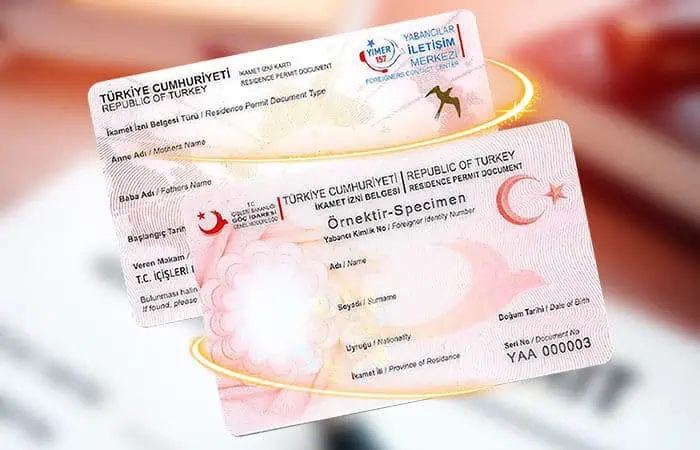
Turkey Residence Permit Fees Go Up 9×: What Foreign Residents Need to Know
From May 1, 2026, the cost of obtaining or renewing a Turkish residence permit increases by roughly 9× under the new fee schedule. Full breakdown of who's affected, the new tiers, how this interacts with the citizenship-by-investment pathway, and what foreign residents and prospective movers should do now.
Approximate fee increase under the new schedule
Effective date — applications submitted from 1 May 2026
Foreign nationals currently holding Turkish residence permits
Citizenship-by-investment threshold (unaffected)
Türkiye's Ministry of Interior and the Migration Management Directorate (Göç İdaresi) confirmed earlier this month that the fee schedule for foreign residence permits will be revised significantly upward from 1 May 2026. The new schedule represents an approximately 9× increase across most permit categories — the largest single-step adjustment to the residence-permit fee structure since the framework was modernised in 2013.
The increase affects all foreign nationals applying for, renewing, or extending Turkish residence permits — including the short-term residence permit (tourism/property-ownership based), family residence permit, student residence permit, and humanitarian residence permits. Turkish citizenship-by-investment applications and existing citizenship holders are not affected.
This briefing covers what's actually changing, who's affected, how the new tiers compare to other jurisdictions, and the practical implications for foreign residents and prospective movers.
Quick summary
- Approximately 9× fee increase across residence permit categories from 1 May 2026
- Affects short-term, family, student, and humanitarian residence permits
- Citizenship-by-investment applicants and existing citizens unaffected
- Applications submitted before 1 May 2026 processed under the old fee schedule
- The increase strengthens the relative economics of the citizenship pathway for long-term residents
What's actually changing
The residence permit fee structure in Türkiye consists of three main components: the permit application fee, the card-issuance fee, and (depending on permit type and applicant nationality) the visa fee. The May 2026 revision affects primarily the application fee — the component that scales most directly with permit duration.
The exact post-increase amounts in Turkish Lira and USD equivalent will be published in the Resmi Gazete in late April. Based on the announced multiplier, expected post-increase ranges are:
The card-issuance fee and visa fee components are increasing proportionally. The total out-of-pocket cost for a typical 2-year short-term residence permit, including all components, rises from approximately USD 200 to approximately USD 1,800 — a meaningful absolute increase, particularly for family applications where multiple permits are required.
Who's affected — and who isn't
Affected:
- Property-ownership residence permit holders — foreign nationals who hold a Turkish residence permit on the basis of owning Turkish property under the threshold for citizenship (i.e. below US$ 400,000)
- Tourist/short-stay residence permit holders — foreign nationals renewing their tourist residence permits
- Family residence permit holders — spouses and dependents of Turkish nationals or residents
- Student residence permit holders — foreign students at Turkish universities
- Work permit holders renewing residence components
Not affected:
- Turkish citizenship-by-investment applicants and holders — the citizenship application fee structure is separate and unchanged
- Long-term residence permit holders (issued after 8+ years of continuous Turkish residence) — these permits do not require periodic renewal
- Diplomatic and special permit categories
- Applications submitted before 1 May 2026 — processed under the old fee schedule even if approved after that date
Why now? The policy context
Türkiye has roughly 1.4 million foreign nationals holding active residence permits — a meaningful demographic that has grown significantly since 2017 when several visa-free entry arrangements and the citizenship-by-investment programme drove inbound migration. The fee adjustment is being characterised by the government as a normalisation, bringing Türkiye's residence permit fees closer to OECD averages.
That framing has merit: pre-increase Turkish residence permit fees were among the lowest in the OECD, far below comparable fees in Spain (~€300–500), Portugal (~€500–700), or Greece (~€1,000+). Post-increase, Türkiye sits much closer to peer European average. The increase also raises material government revenue — early estimates from the Ministry of Finance suggest the new fee schedule could generate USD 1.2–1.8 billion annually at current application volumes.
"For most foreign residents, this is an absorbable increase — meaningful but not blocking. For long-term residents (3+ years), the math now clearly favours converting from successive residence permits into the citizenship-by-investment pathway."
The math: when does citizenship become cheaper than renewing residence?
The increase materially shifts the relative economics of the two pathways. Consider a family of four (two adults, two children) maintaining residence permits across 10 years vs pursuing citizenship-by-investment:
The pure fee math now favours citizenship for any family planning 5+ years of Turkish residence. The property investment delivers both the citizenship and a tangible asset that retains value; the residence-permit pathway delivers no equivalent asset and accumulates fees year-on-year.
For families already considering a Turkish property purchase, the increase strengthens the case substantially. For families currently on residence permits who haven't considered citizenship, this is the moment to model it.
What to do if you're affected
If you're applying for the first time
If you have a pending move to Türkiye, submit your residence permit application before 1 May 2026 if possible. Applications submitted before that date are processed under the old fee schedule, even if final approval comes after. This is a meaningful saving — ~USD 1,600 per applicant on a 2-year permit at the simplest tier.
If you're renewing soon
Renewals can typically be submitted from 60 days before your current permit expires. If your current permit expires between May and August 2026, check whether early renewal under the old fee schedule is permitted in your case — it usually is, and the saving is significant for family applications.
If you're a long-term resident
Model the citizenship-by-investment pathway against continued residence renewals. For most long-term residents — especially those who would benefit from a second passport — the increase tips the math decisively toward citizenship. We model this scenario for clients at no cost as part of our buyer guide consultation.
If you're considering a Turkish property purchase
The increase doesn't directly affect property purchase costs, but it changes the value of holding US$ 400,000+ in Turkish property: with the residence permit pathway becoming more expensive over time, the citizenship route is now even more attractive as the long-term solution. The recent 20-year tax holiday announcement reinforces this picture.
How Türkiye compares internationally after the increase
Even after the 9× increase, Türkiye's residence permit fees remain mid-pack against peer jurisdictions, and meaningfully cheaper than the European Mediterranean alternatives:
- Türkiye (new): ~USD 720–1,800 per applicant per permit cycle
- Portugal D7: ~EUR 500–700 per applicant per cycle, plus higher cost-of-living thresholds
- Spain non-lucrative: ~EUR 300–500 per applicant, plus financial requirements of ~EUR 30K+
- Greece (after recent reforms): ~EUR 1,000+ per applicant, plus property minimum EUR 250K–800K
- UAE (Golden Visa): ~USD 3,000–5,000 per 10-year visa, plus property minimum AED 2M (USD 545K)
The relative value proposition of Türkiye for international residents — combining lower cost of living, accessibility, and the existing citizenship-by-investment pathway — remains intact even after the increase. The key shift is that residence permits no longer represent the cheapest path to long-term Turkish stay; for serious long-horizon investors, the citizenship route is now decisively the better economic choice.
Your partner for the new permit landscape
We help foreign nationals navigate Turkish residency, citizenship, and property — including the strategic question of which pathway is right for your situation.
150+ Citizenship Cases
Full handling of the citizenship-by-investment pathway — property selection, legal due diligence, and the application itself.
Legal & Immigration Specialists
In-house Turkish lawyers and immigration consultants — we handle residence permit applications, renewals, and the conversion to citizenship.
Premium Property Inventory
Direct access to citizenship-eligible properties from $400K up to luxury branded residences at Mandarin Oriental, Ritz-Carlton, and Caja Maxx Royal.
After-Sale Management
Full property management for non-resident owners — leasing, tax filings, and remittance.
Multilingual Team
English, Arabic, Russian, Turkish, Persian — we work in your language and cultural context, not just translate.
Transparent & Licensed
Licensed real estate brokerage in Türkiye. Transparent fees, no hidden charges, written contracts.
Residence Permit Fee Increase — FAQ
The most common questions we've received since the announcement.
Considering Turkish citizenship instead?
The fee increase tips the math toward citizenship-by-investment for most long-term residents. Get a personalised analysis of the citizenship pathway and a curated property shortlist matching your budget. Free, no commitment.
WhatsApp: +90 536 637 1201 Read the Citizenship GuidePlan Your Next Move
Tell us your current situation — residence permit type, family size, timeline — and we'll send you a free analysis of both the renewal and citizenship pathways, plus a tailored property shortlist if relevant. 24-hour response.



Join The Discussion