

Branded Residences in Turkey: What the Name on the Door Actually Buys
Ritz-Carlton in Nişantaşı, Four Seasons above Levent, Mandarin Oriental on a private Aegean bay. The brand is the easy part to understand. What it commits to, for how long, and at whose cost is the part worth reading closely.
You are not buying the logo. You are buying an operating commitment.
The branded residence is one of the few genuinely new categories in international property, and Turkey now has a serious cluster of them — concentrated in Istanbul and on the Bodrum peninsula, with names attached that need no introduction anywhere in the world.
The category is widely misunderstood, usually in the same direction. Buyers assume the brand is a decorative premium: the same apartment, with a better name and a higher price. That is close to the opposite of how it works. In a branded residence you buy the property in the ordinary way and hold the title deed in your own name, exactly as you would with any Turkish apartment. What the brand supplies is not the bricks. It is the operation — the concierge desk, the housekeeping standard, the maintenance regime, the staff training, and the accountability that follows from a hospitality company putting its name above your front door.
Turkey's branded stock divides into two quite different models, and buyers regularly conflate them. Some are standalone residential buildings that carry a hotel brand's service without being a hotel. The Ritz-Carlton Residences in Nişantaşı is described as a standalone branded residential development rather than a hotel, and Four Seasons Private Residences Istanbul is likewise a standalone residential tower that is not part of a hotel. Others sit inside a working resort estate, where owners draw directly on a live hotel operation.
What follows is how the category works in Turkey, four developments that illustrate the range, and the checks that belong in your due diligence alongside the ordinary ones on title, permits and zoning.
Four Turkish Examples
Illustrating the range of the category
Four developments, four different propositions
Taken together these show how wide the category is in Turkey — from a discreet city tower to a 60-hectare estate on the Aegean.
The Ritz-Carlton Residences, Istanbul — the discreet city address
In the heart of Nişantaşı, at the meeting point of Şişli, Beşiktaş and Beyoğlu, this is a 22-storey landmark of 121 units, redesigned from a 1970s tower by the architect Tanju Özelgin and developed by BLG Capital, an affiliate of Bilgili Holding. It is Europe's first Ritz-Carlton branded residence, and it is a standalone residential development rather than a hotel — residents receive the brand's service inside a private setting. The published offer runs to 24/7 concierge, valet parking, fitness centre, indoor pool, a spa with hammam, private cinema, children's play area, personal chef service and housekeeping, along with access to the global Ritz-Carlton network. Homes range from 1+1 apartments through to eight-bedroom penthouses. Read the full guide.
Four Seasons Private Residences Istanbul — the low-rise, low-density option
Positioned at the convergence of Ulus, Etiler and Levent, and created by Tay Group in collaboration with Four Seasons Hotels and Resorts, this is the quiet counter-argument to the tower. It runs to just 82 units across 46 distinct floor plans and rises no higher than seven floors — a deliberately low-density proposition where almost every home is different. Residents have a dedicated Director of Residences as well as a 24-hour residential concierge, with a heated indoor pool, spa, golf simulator, private cinema, fitness centre, yoga and Pilates rooms, a children's area and EV charging. Like the Ritz-Carlton, it is a standalone residential tower rather than part of a hotel. Read the full guide.
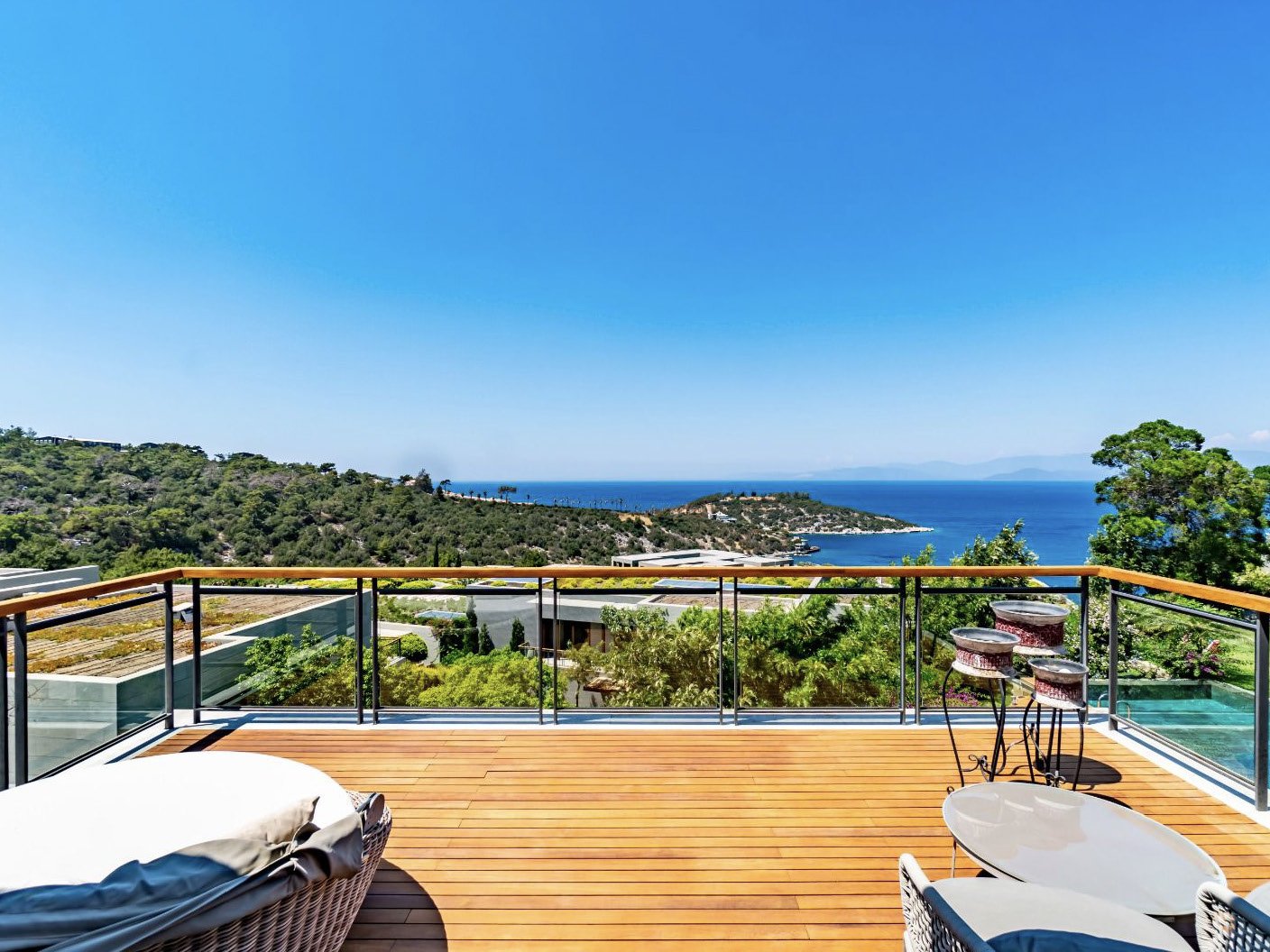
Mandarin Oriental Bodrum — the full resort estate
A different proposition entirely. Set on Paradise Bay across a 60-hectare private estate with 1.5 kilometres of private Aegean coastline and beaches, roughly 45 minutes from Milas-Bodrum International Airport. Owners have the run of the estate: a private beach club, an award-winning spa, several restaurants and bars, fitness facilities, tennis and padel courts, yoga studios, marina access and a kids' club. The service model is the deepest of the four — in-villa dining, housekeeping, butler service, chef hire, personal trainer, spa treatments and chauffeur, all bookable on demand, with hotel residences receiving daily housekeeping, turndown and full in-residence dining. Owners of hotel residences may also place the unit into the Mandarin Oriental rental programme when not using it. Read the full guide.
Rixos Tersane Istanbul — the branded quarter
The largest in scope, and the one that stretches the definition. Built on the western bank of the Golden Horn — a 7.5-kilometre natural harbour, minutes from Sultanahmet, Hagia Sophia, the Blue Mosque and Topkapı Palace — the site was an Ottoman naval shipyard carrying six centuries of maritime heritage, and the design sets restored industrial architecture against contemporary glass and steel. The masterplan covers 242,000 square metres and includes 660 residential apartments, four luxury hotels with Rixos as flagship, 270 retail and dining venues, a 140-berth yacht marina, 150,000 square metres of open public space, two cultural museums and 20,000 square metres of offices. Apartments come with hotel-level service, concierge, housekeeping and room service. Read the full guide.
Six things you are actually paying for
Strip away the marketing and this is what a hospitality brand brings to a residential building.
An enforced standard
Brands audit the buildings that carry their name. That audit is the mechanism by which a lobby still looks right in year fifteen — and it is the single most valuable thing the licence buys.
Trained staff and a real desk
A 24-hour concierge, and in some buildings a dedicated Director of Residences, means requests are handled by people with hospitality training rather than by a caretaker with a phone.
A maintenance regime
Plant, lifts, pools and common parts run on planned schedules rather than on complaint. This is invisible when it works and ruinous to a building's value when it does not.
Amenity that is operated, not just built
Any developer can build a spa. Keeping it properly staffed and maintained a decade later is an operating commitment, and it is what distinguishes a branded amenity from a photographed one.
Recognition at resale
A globally known name gives a future buyer — very possibly one who has never visited Turkey — a reference point they already trust. That legibility is part of the asset.
A turnkey absentee model
For an owner who lives abroad, a building that already runs itself is the whole proposition. Where the brand also operates a rental programme, the hands-off case gets stronger still.
Branded residence vs conventional luxury apartment
Where the two genuinely differ — and where the difference is smaller than the marketing suggests.
| Point of comparison | Branded residence | Conventional luxury apartment |
|---|---|---|
| You hold the title deed in your own name | Yes | Yes |
| Open to foreign buyers on the same terms | Yes | Yes |
| Service standard contractually enforced by a third party | Yes — the brand audits it | No — depends on the management company |
| 24-hour trained concierge | Common baseline | Occasional |
| Housekeeping and in-residence dining available | Often, on demand | Rare |
| Operator-run rental programme | Sometimes, and usually optional | You arrange it yourself |
| Recurring service charge | Higher, reflecting the staffing | Lower |
| Brand licence can expire or be withdrawn | Yes — a real risk to diligence | Not applicable |
| Standard Turkish purchase process applies | Identical — title, annotations, occupancy permit, zoning, secure payment system. | |
| Price, service charge and rental terms | Development-specific and subject to change. Confirm current figures directly. | |
The four questions ordinary due diligence misses
Everything that applies to any Turkish purchase applies here too: read the annotations on the title deed, confirm the occupancy permit, check the zoning, and complete through the regulated secure payment system. Our guide to the pitfalls foreign buyers still fall into covers that ground properly, and none of it becomes optional because there is a famous name involved.
What the standard checklist does not cover is the brand relationship itself. Four questions close that gap.
How long is the licence, and what happens at the end of it? The brand operates under a contract with the developer or the owners' association. Ask for its length, its renewal mechanism and who holds the decision. This is the question most likely to be met with a vague answer, which is itself informative.
What exactly does the service charge cover? Get the current figure and the list of what it buys. Then get the list of what it does not — the services billed per use. In estate-model developments especially, the gap between “available” and “included” is where budgets go wrong.
Who controls the management company? The developer, the brand, or the owners? This determines who you can hold to account once the sales suite has closed, and how much say owners have over future increases.
If there is a rental programme, what are its terms? The revenue split, the length of commitment, any cap on your own personal use of the property, and whether enrolment is genuinely optional. At Mandarin Oriental Bodrum, enrolment in the rental programme is explicitly optional; do not assume that is universal.
If the purchase is intended to support a Turkish citizenship application, treat that as a separate workstream with its own requirements — the officially assessed value has to meet the threshold in force at the time, and the property has to carry the required annotation. Our Turkish citizenship by investment page sets out the route; confirm the current threshold and conditions with a licensed adviser rather than relying on any figure you read in an article.
This guide is general information for international buyers, not legal, tax or investment advice. Development details are as published on our own project pages and are subject to change by the developer or operator. Prices, service charges, brand licence terms and citizenship thresholds all change — confirm current figures with us and with a licensed adviser before you act.
Considering a branded residence in Istanbul or Bodrum?
We will pull the licence term, the service charge schedule and the rental programme terms before you make an offer — not after.
Branded residences in Turkey — frequently asked questions
The questions international buyers ask most often about how the category works and what to check.
Where to go next
The individual development guides, and the buyer library behind them.
- The Ritz-Carlton Residences, Istanbul — Europe's first Ritz-Carlton branded residence, in Nişantaşı.
- Four Seasons Private Residences Istanbul — 82 homes across 46 layouts at Ulus.
- Mandarin Oriental Bodrum — villas and residences on a 60-hectare Aegean estate.
- Rixos Tersane Istanbul — 600 years of maritime heritage on the Golden Horn.
- Zorlu Center Istanbul — the mixed-use residential landmark in Beşiktaş.
- Yalıkavak luxury villas — the marina end of the Bodrum peninsula.
- Buying property in Turkey: the pitfalls — the checks that apply to every purchase.
- Property management and rentals — running a Turkish property from abroad.
- Turkey property guides — the full library for international buyers.
See the branded stock properly
Tell us how you intend to use the property — a few weeks a year, a permanent move, or an income asset — and we will show you which of Turkey's branded residences actually fits, and what each one will cost you to run.

Join The Discussion